

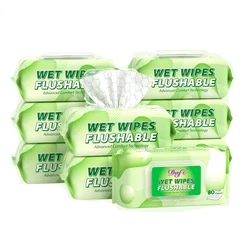



Hangzhou Haoyue Personal Care Co., Ltd. is one of the most credible manufacturers and suppliers of compostable menstrual pads in China. Please rest assured to buy bulk high quality compostable menstrual pads from our factory. We also accept customized orders.
Key Specifications
| Item | Typical / Option |
|---|---|
| Product name | Compostable Menstrual Pads |
| Target user | Eco-conscious consumers; retailers and wholesalers seeking certified compostable pads |
| Sizes | 200 mm (light) / 240 mm (day) / 300–350 mm (overnight) - custom sizes available |
| Top sheet | Organic cotton or PLA nonwoven (certified; no dyes/fragrance) |
| Absorbent core | FSC pulp (chlorine-free) ± bio-based absorbent modifiers (starch-derivatives); reduced/alternative SAP options on request |
| Backsheet | Compostable film (PLA/PBAT blend or certified compostable laminate) - industrial-compostable grade |
| Wings | Compostable material option; adhesive strip designed to be compost-friendly |
| Packaging | Compostable inner wrap + recycled carton (options for BPI / OK compost labelled packaging) |
| Typical absorbency | 40–120 mL (SKU dependent) |
| Thickness | ~2.0–5.0 mm (depending on absorption target) |
| Compostability target | ≥ 90% biodegradation in industrial composting within 6 months (per EN 13432/OK criteria) - certification via third party required |
| Shelf life | 2–3 years (packaged, dry storage) |
| MOQ | Flexible; typical starting ranges 30,000–100,000 pcs per SKU (pilot runs negotiable) |
Functional Benefits & Technical Rationale

1) Verifiable Compostability
We use industrially compostable materials for backing films, outer packaging, and (where possible) cover sheets. We recommend obtaining EN 13432 / OK Compost Industrial / BPI or equivalent certification to verify the compostability and residual toxicity of the final product. Certification demonstrates decomposition rate, toxicity, and the absence of harmful residues.
2) Lower Fossil-Plastic Weight
Replacing traditional PE/PP backing films with a wood pulp-based core and compostable film significantly reduces the amount of non-degradable plastic in a product (the specific percentage depends on the final product formulation). For example, some brands use organic cotton or PLA backing films to minimize plastic.


3) Performance Trade-Offs & Engineering
Traditional SAP (super absorbent polymer) is generally difficult to commercialize as a fully compostable material. If a fully compostable formulation is desired, common strategies include reducing the SAP content, increasing the pulp ratio, or using new biodegradable absorbents (which are under development and have varying performance/cost characteristics). These factors affect thickness and retention under extreme flow rates, so products should be positioned and tested for "daily use/lightweight-medium flow."
4) Skin safety & odor management
Both the topsheet and adhesive should be formulated with a low-irritation formula. Odor management can be achieved through activated plant fibers or natural adsorption layers (for example, non-petroleum-based activated carbon), ensuring that these additives are compostable or recyclable.

Technical & Lab Metrics
Acquisition time (s) - speed at which liquid transfers from topsheet to core (target ≤ 5 s for good UX).
Wetback (g) - surface rewet under pressure (target ≤ 0.5–1.0 g for comfort).
MVTR /Moisture permeability (g/m²·24h) - breathability(Index (recommended value 500–2500 depending on the film material).
Compostability result - % biodegradation at 180 days in industrial composting (EN 13432 style test).
Heavy metals / ecotoxicity - must meet limits per EN 13432 / BPI (to avoid negative compost quality).
PFAS & extractables panel - third-party screening available on request (growing procurement requirement).
Customization & OEM Services (What Haoyue Offers)

Material Mix: Choose from different combinations of organic cotton/PLA topsheet, FSC pulp core, and compostable film backsheet to balance performance and compostability.
Absorbency Profiles: Adjust absorbency/thickness based on target market (schools, retail, hygiene projects).
Branding & Labeling: Provide certification logos (after obtaining third-party certification) and customized packaging (compostable and recyclable options).
Testing & Documentation: Support third-party compostability tests, heavy metals/PFAS screening, dermatology reports, and product technical manuals.
Pilot Runs & Scale: Support sample validation and market testing plans, from small batch samples to mass production (samples: 7–14 days; small batches: 2–4 weeks; mass production: depending on customization complexity).
Product customization

Packaging customization

Technological advantages

Packaging and shipping

Our partner brands


Our Certificates

FDA

SGS

FDA

ISO

ERP

CELAB
Customer Visits


Our exhibition

FAQ
Q: Can these sanitary napkins decompose in a home compost bin?
A: Most materials certified for industrial composting require high temperatures and aeration, making them difficult to maintain for home composting. Therefore, it is generally recommended that these products be placed in industrial composting facilities. If home composting is the goal, specialized "home compostable" certification is required.
Q: Can they be 100% plastic-free?
A: Technically, organic cotton, bonded pulp, and biodegradable film can achieve "free from traditional petrochemical plastics," but this requires balancing absorbency, cost, and certification requirements. Certain absorbent additives and adhesives must also be replaced with biodegradable formulations. The actual formulation must be verified by third-party testing.
Q: How long does certification (OK/BPI/EN) take?
A: The third-party certification process takes time depending on the preparation of materials and sample testing. Sample testing and reporting typically take weeks to months, depending on the arrangements between the laboratory and the certification body.
Q: Can PFAS/toxicological residues be tested?
A: Yes. Many buyers now require PFAS and other chemical residue testing. We can commission accredited laboratories to conduct targeted analysis and include it in the certificate of conformity.
Q: Will it be significantly more expensive than regular sanitary napkins?
A: Using compostable materials (organic cotton, PLA film, FSC pulp) and obtaining certification typically increases raw material and testing costs; however, with scaled procurement and optimized formulations, the cost gap can be narrowed. We offer formulations at varying price points and performance levels for wholesalers to choose from.