


When planning a baby care product range, buyers often need to decide between traditional baby diapers and pull-up baby pants.
For parents, the difference is mainly about fit and changing convenience. For distributors and private label brands, the decision also involves product positioning, target age, packaging and SKU planning.
Baby Diapers: A Flexible Choice for Early-Stage Care
Traditional baby diapers normally use fastening tabs, allowing caregivers to adjust the fit during a diaper change.
They are commonly used for younger babies who still need caregiver-assisted changes. Their structure can also be designed for different absorbency requirements, sizes and market price levels.
For brands serving newborn and infant markets, baby diapers can therefore form the foundation of a wider diaper range.
Baby Pants: Designed for More Active Babies
Baby diaper pants use a pull-on construction rather than traditional fastening tabs.
This format is particularly useful when babies become more active, such as when they start crawling, standing or walking. The elastic waistband allows the product to move with the child, while tear-away sides can make removal easier. Haoyue describes its diaper pants as suitable for active babies and provides M, L, XL and XXL specifications.
For buyers, this makes baby pants an interesting category when developing products for older infants and toddlers.
What About Training Pants?
Training pants occupy a slightly different position.
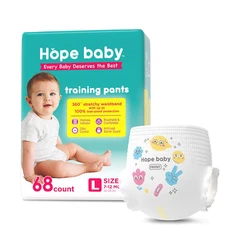
They are designed as a transition between diapers and regular underwear during toilet training. The pull-up design gives toddlers more independence, while the absorbent structure provides protection against accidents.
Haoyue's training pants page lists disposable options and multiple product concepts, including 18-month training pants, nighttime training pants, bedtime training pants and bamboo training pants.
Its training diapers are also available in M, L, XL and XXL specifications, with listed absorbency levels from 500 ml to 650 ml depending on size.
How Should Buyers Build Their Product Range?
For B2B buyers, there is no need to treat baby diapers and baby pants as competing products.
They can serve different positions within the same product portfolio:
Baby Diapers
→ Younger babies and caregiver-assisted changes
Baby Pants
→ Active babies and toddlers who need a pull-on format
Training Pants
→ Children moving toward toilet independence
This product structure can help brands cover different stages rather than relying on one diaper format.
What Should Private Label Buyers Compare?
When sourcing from a diaper pants manufacturer, look beyond the product appearance.
Compare the following specifications:
- Size range and weight guidance
- Absorbent core structure
- Absorption capacity
- Topsheet and backsheet materials
- Waistband and leg fit
- Leak protection
- Packaging options
- MOQ and production capacity
- OEM/ODM customization
Haoyue's diaper pants use a structure including nonwoven material, air-laid paper, SAP, leak guards, PE backsheet and a wetness indicator. These details give buyers a useful starting point when discussing their own product specifications with a manufacturer.
Baby Pants or Baby Diapers?
The answer depends on the market you are serving.
If your product line focuses on younger infants, traditional baby diapers can provide the core range. If your target customers include parents of active babies and toddlers, baby diaper pants can extend the range with a pull-up format.
For brands planning a broader baby care portfolio, adding training pants and training diapers can further cover the transition toward toilet training.
Instead of choosing only one format, buyers can build several SKUs around different stages and purchasing needs. This approach also gives private label brands more room to develop product tiers and packaging strategies.